Start-Middle-End
Introduction
Generic, Minimalistic, for small and mini projects, and specific tasks on the 'task versus project borderline' (too small for a project, too big for a task). SME is the latest methodology for managing complex tasks that can be regarded as mini projects. In case of SME, the difference between project and Business as Usual (BaU) is not so evident. Moreover, line functions can trigger mini projects. So projects can be anywhere in the organization, or across people networks.
The advantage of SME is recognition of project skills without the bureaucracy and complexity of academically oriented methodologies, bodies of knowledge and standards. It is a stepping stone, from lack of project awareness to simple project management, to complex project management.
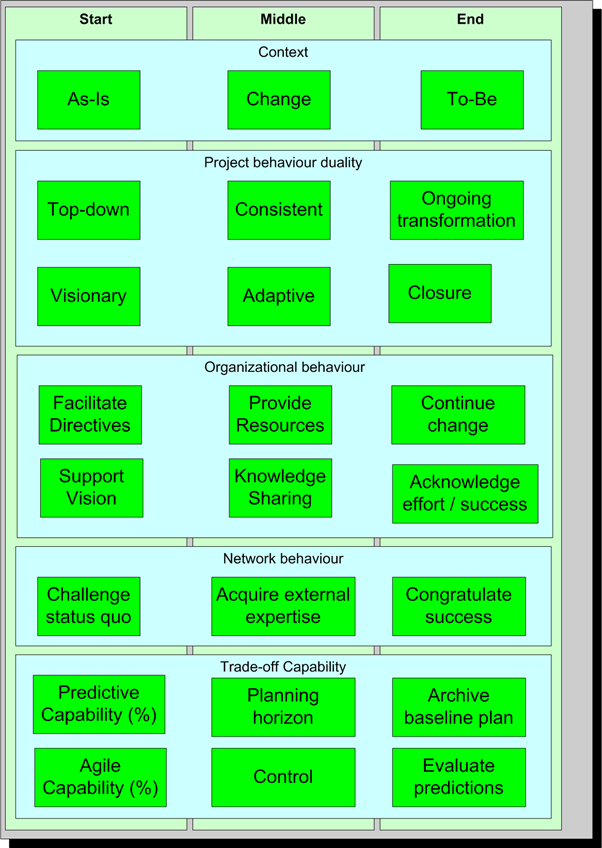
Start-Middle-End has three lifecycle stages and five perspectives. Perspectives consist of elements which relate to Start, Middle, or End (a particular moment in time).
Preview
Context
The first perspective is Context, consisting of three elements: As-Is, Change, and To-Be. As-Is relates to Start, Change relates to Middle, and To-Be relates to End.
Context implies an analysis of the current situation and an idea of the ideal, or improved situation. Change in the middle
Read more...