Few landscapes in Indonesia command attention quite like Padar Island. Its sweeping ridgelines, three curved bays, and layered horizons create one of the most photographed views in Southeast Asia. But beyond the classic sunrise snapshot lies a deeper question for photographers and travellers alike: is Padar Island more powerful at golden hour or blue hour?
Golden Hour: Warmth, Drama, and Contrast
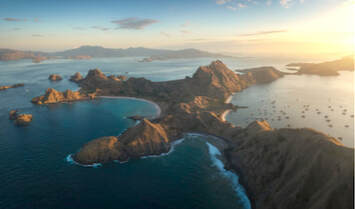
The golden hour on Padar Island, typically just after sunrise or before sunset, bathes the hills in soft amber tones. The dry grass glows, shadows stretch long across the ridges, and the turquoise waters deepen and become more saturated. It’s cinematic. It’s bold. It feels triumphant.
This is the light most associated with Padar on social media. It amplifies contrast between land and sea, making the three crescent bays visually dramatic. The result? High-impact images that immediately grab attention.
Emotionally, golden hour feels:
- Energising
- Adventurous
- Iconic
- Statement-making
If your goal is to capture a powerful travel moment that radiates warmth and vitality, golden hour delivers.
Blue Hour: Calm, Depth, and Atmosphere
Blue hour — the period just before sunrise or just after sunset — is subtler. The sky shifts to soft indigo and muted lavender tones. The island’s ridges become silhouettes, and the sea reflects cooler hues.
Where golden hour is bold, blue hour is introspective.
Emotionally, blue hour feels:
- Serene
- Reflective
- Minimalist
- Cinematic in a quieter way
The absence of harsh contrast allows for smoother gradients and softer transitions. It’s less about drama and more about atmosphere.
Lighting & Color
Golden hour enhances texture. The directional sunlight creates depth through shadow and highlights, making Padar’s layered hills pop in photographs.
Blue hour, on the other hand, simplifies the composition. Without strong directional light, the scene becomes more graphic — almost abstract — with smoother tonal transitions.
If you’re shooting:
- For vibrant Instagram content → golden hour tends to perform better.
- For editorial, moody storytelling → blue hour often feels more refined.
Crowd Dynamics
The golden hour, especially sunrise, attracts more hikers and photographers. You may need to frame carefully to avoid silhouettes of other visitors.
Blue hour can feel more exclusive. Fewer people linger after sunset, and pre-dawn arrivals are often quieter. The mood is slower and more intimate.
Camera Settings
Golden hour:
- Lower ISO
- Faster shutter speeds
- Natural color vibrancy
Blue hour:
- Tripod recommended
- Slightly longer exposure
- More emphasis on white balance control
Each hour demands a different approach — and tells a different visual story.
Which Moment Truly Wins?
So which moment truly wins on Padar Island?
The honest answer: it depends on your intention.
Choose golden hour if:
- You want a classic, high-impact Padar photo.
- You’re creating content for travel marketing.
- You love warmth, contrast, and bold visual storytelling.
Choose blue hour if:
- You seek a more emotional, atmospheric frame.
- You prefer minimalism and softer tones.
- You want Padar to feel personal rather than iconic.
For many photographers, the real winner is experiencing both. Arrive before sunrise to capture blue hour’s calm mystery, then stay as golden light gradually transforms the hills. The shift itself becomes part of the story from quiet anticipation to radiant reveal.
Padar Island isn’t just about one perfect moment. It’s about how light reshapes the same landscape into two entirely different emotional experiences.
Golden hour may dominate postcards. Blue hour may win in subtlety.
The true victory belongs to the photographer who understands what story they want to tell.